
The transition from higher education to the professional workforce is often framed around a single, high-stakes milestone: securing the degree. Landing a diploma is undeniably crucial, but focusing solely on the final credential overlooks the engine that builds professional capability: coursework.
In the modern, data-driven hiring landscape, employers are looking past the parchment. They want to know what a candidate can actually do on day one. Academic coursework is not merely a series of administrative hurdles designed to clear a graduation requirement; it is a rigorous, structured simulator for the real-world marketplace. From mastery of technical competencies to the development of cognitive endurance, high performance in semester-long projects, lab reports, and case studies serves as a primary indicator of future career trajectory.
Key Takeaways
- The GPA Gateway: Major employers in finance, tech, and engineering still utilize coursework performance and GPA as a primary screening mechanism for entry-level roles.
- Skill Translation: Coursework directly replicates workplace deliverables, transforming theoretical knowledge into measurable technical and soft skills.
- The E-E-A-T Framework for Students: Building academic credibility through rigorous coursework establishes the baseline for professional expertise, authoritativeness, and trust.
- Long-Term ROI: Consistently high performance throughout college correlates directly with faster promotion cycles and higher starting salaries.
1. The Real-World Translation: How Coursework Simulates the Modern Workplace
Academic modules are frequently misunderstood as abstract intellectual exercises. In reality, modern higher education curricula are engineered in tandem with industry advisory boards to ensure that assignments mirror corporate deliverables.
When a student undergoes a comprehensive coursework module, they are not just earning a grade; they are undergoing a professional trial run. For instance:
- Business and Finance Case Studies duplicate corporate risk assessments and market entry strategies.
- Engineering Lab Reports mimic technical documentation, quality assurance protocols, and compliance filings.
- Computer Science Problem Sets build the algorithmic thinking and debugging stamina required in agile software development environments.
According to a survey by the National Association of Colleges and Employers (NACE), employers consistently rank attributes like problem-solving skills (61.2%) and teamwork (61.0%) as top priorities on a candidate’s resume. Coursework is the primary incubator for these competencies. Managing multiple midterms, drafting extensive research papers, and balancing team dynamics in group projects requires the exact same self-regulation, time management, and project tracking utilized by corporate project managers.
2. Navigating Academic Pressure to Secure Professional Advantages
The volume of coursework assigned in competitive US universities has risen exponentially over the past decade, driven by increasingly complex global market demands. Students are frequently tasked with managing advanced data analysis, legislative research, and strategic communication frameworks simultaneously. When the academic burden threatens to compromise a student’s strategic focus, leveraging specialized academic support becomes a viable operational decision to maintain a high GPA.
If you find yourself overwhelmed by an unsustainable volume of technical papers, choosing to pay someone to do my course work can act as a critical safety valve. Outsourcing baseline research or complex structural formatting to professional academic writers allows students to allocate their mental bandwidth toward mastering core, high-impact major modules, preparing for technical interviews, and securing competitive internships. This balance ensures that overall academic performance remains pristine while preventing burnout—a critical skill in long-term career sustainability.
Maintaining a flawless academic record is essential because your cumulative performance reflects your operational reliability. When recruiters review a transcript filled with top marks across intensive modules, they infer that the candidate possess the work ethic, cognitive capability, and attention to detail necessary to handle high-stakes corporate portfolios.
3. Data-Driven Insights: The Tangible ROI of High Academic Performance
The relationship between academic performance and financial trajectory is backed by substantial economic data. A landmark study published in the American Journal of Education revealed that a one-point increase in a student’s GPA is associated with a 12% increase in annual earnings for men and a 14% increase for women later in life.
Furthermore, elite corporate sectors—including tier-one management consulting firms, investment banks, and fortune 500 leadership development programs—utilize strict GPA cutoffs (typically a 3.5 or higher) during the initial automated resume screening process.
Visualizing the Journey: The Skill-to-Salary Bridge
To understand how daily academic effort transforms into long-term financial premium, consider the sequential progression from the classroom to corporate advancement:
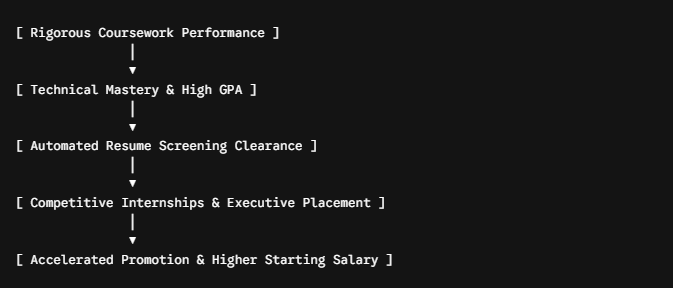
When students leverage comprehensive educational platforms to make my assignment flawless, they are protecting this pipeline. Ensuring that every submitted paper, mathematical model, or strategic brief aligns with top-tier academic standards directly reinforces the cumulative GPA, keeping the doors to elite corporate recruitment wide open.
4. Building E-E-A-T from the Classroom to the Boardroom
Google’s search evaluation guidelines emphasize E-E-A-T: Experience, Expertise, Authoritativeness, and Trustworthiness. While this framework is used to evaluate web content, it serves as an excellent blueprint for professional career development.
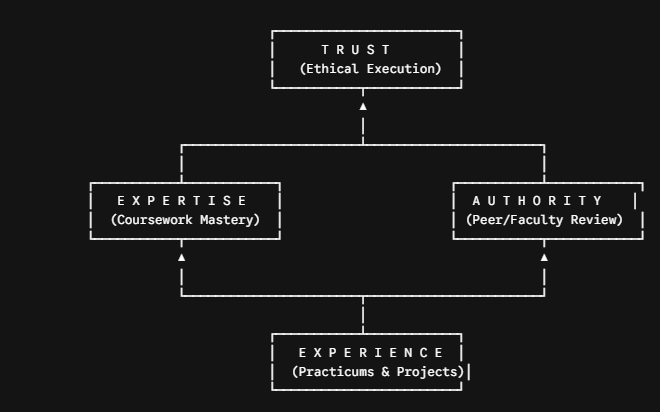
Experience & Expertise
Your coursework is your initial proof of concept. Writing a 15-page financial analysis paper or executing a full-stack coding project gives you tangible, hands-on experience before you ever step into an office. The deep focus required to score an ‘A’ in these modules translates directly into domain expertise.
Authoritativeness & Trust
When you consistently deliver top-tier coursework, you earn the validation of your professors—who are themselves established industry authorities. This leads to strong letters of recommendation, invitations to research fellowships, and introductions to exclusive alumni networks. In the corporate world, this authority acts as your currency, signaling to stakeholders that your insights are trustworthy and backed by data.
5. Overcoming the “Catch-22” of Entry-Level Hiring
The modern entry-level job market presents a notorious paradox: “You need experience to get a job, but you need a job to get experience.” High performance in specialized coursework breaks this cycle.
Advanced coursework often includes capstone projects, practicums, and thesis research. These are not simple essays; they are comprehensive, multi-month initiatives that yield physical or digital assets. Students can compile these high-scoring coursework deliverables into a professional portfolio. Presenting a well-documented market research brief or an optimized software architecture plan during an interview provides empirical proof of skill, rendering the “lack of formal office experience” irrelevant to discerning hiring managers.
Conclusion: The Classroom is Your Corporate Launchpad
Every syllabus handed out at the start of a semester is a strategic map of industry-relevant competencies. Treating coursework as a series of low-stakes chores is a missed opportunity to build professional momentum. By committing to high coursework performance, leveraging academic support systems when necessary to protect your GPA, and approaching every assignment with professional rigor, you transform your academic journey into a launching pad for long-term career success.
Frequently Asked Questions (FAQ)
Q1: Do employers actually check college transcripts or look at coursework?
Yes. While some industries prioritize portfolios or technical coding tests, sectors such as finance, engineering, government, defense, and consulting require official transcripts during the onboarding process to verify GPA, core competencies, and academic integrity.
Q2: How can I showcase my coursework performance on a resume?
Instead of simply listing course titles, create a “Relevant Coursework” or “Selected Academic Projects” section. Use bullet points to describe the scope of your major projects, the tools used (e.g., Python, SPSS, Excel), and the outcomes achieved, framing them exactly like professional work experience.
Q3: Is GPA more important than internship experience?
They are complementary. An excellent internship provides practical exposure, but many high-caliber internships utilize GPA minimums as an initial filter. Maintaining strong coursework performance ensures you qualify for the very internships that accelerate career growth.
Q4: How does coursework help in developing soft skills?
Group coursework replicates corporate cross-functional teams. It teaches you how to manage differing opinions, delegate tasks, meet strict deadlines, and navigate professional conflicts—skills that are essential for leadership promotion in any corporate structure.
See also: How Technology Is Reshaping the Media Industry
References & Data Sources
- National Association of Colleges and Employers (NACE): Job Outlook Survey, identifying core competencies and attributes sought by corporate recruiters.
- American Journal of Education: Longitudinal data analysis regarding the direct correlation between cumulative GPA margins and mid-career financial compensation.
- Georgetown University Center on Education and the Workforce: Reports on the monetization of specific academic majors and the impact of rigorous collegiate training on workplace performance.
About the Author
Dr. Evelyn Vance is a Senior Academic Strategist and Lead Content Contributor at MyAssignmentHelp. With over 14 years of experience in higher education consulting and curriculum development across US and UK universities, Dr. Vance specializes in helping students transition smoothly from academic environments into elite corporate spaces. Her research focuses on aligning student pedagogical outcomes with modern corporate hiring metrics.
